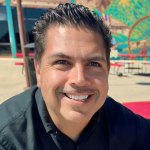

The stools inside industrial arts teacher David Abel’s class were flipped upside down, resting on top of the tables, with four tennis balls posing as heels.
The room at La Cumbre Junior High School in Santa Barbara is typically filled with dozens of students, but on Tuesday, the room was empty amid the COVID-19 pandemic.
“I didn’t know how much I missed my classroom until I walked in today and I don’t have kids lining up, shaking their hands, introducing, ‘Hi, I am Mr. Abel, and you are?’” he said. “I am still trying to give that atmosphere to them.”
The 2020-21 school year began online Tuesday for about 12,647 students in the Santa Barbara Unified School District. According to attendance numbers provided by the district, about 316 students did not go to school, or log in to their classes, with most of those — about 222 — in the elementary grades.
For the teachers, staff and administrators, the day marked a significant milestone in their effort to provide distance learning to the thousands of students in the district. The State of California in July ordered the Santa Barbara district to begin the school year with distance learning because it was one of the counties on the state’s watchlist for rising COVID-19 cases.
In a twist, the county on Tuesday announced that local schools could now apply for a waiver to reopen for in-person learning, now that cases have dropped again. The waiver applications could take two weeks to be considered and get a decision.

For now, however, students are putting aside their first-day pictures in front of their school or classroom and instead taking pictures at their home desks, where they will be learning for the time being.
It’s just the latest turn for a generation of students who are growing up during the pandemic, and life as they knew it a year ago has been turned on its head. The district has seen enrollment drop by 140 students for the coming year, some leaving in favor of homeschooling or private school, while those who have remained committed to public schools know that unpredictabilty is about the only thing that students and families can count on.
“I certainly understand parents’ fears and their concerns regarding their children being on screen for a long period of time,” said Hilda Maldonado, the district’s superintendent. “Our teachers have taken great care to build in breaks. I want to remind people that even though we are in a pandemic that doesn’t mean we can’t move, and use music and other ways to get us going.”

Teachers have the option of instructing from home or in their normal classrooms.
At Harding University Partnership School, sixth-grade teacher Megan Reed was one of the teachers who chose the classroom to reach her students. She said Tuesday went “better than expected.”
“The kids are ready,” she said. “They want to be back at school. What I have seen from them is that they have a renewed enthusiasm.”
The pandemic forced the closure of schools in mid-March. The district and teachers did their best to provide education for the remainder of the year.
“Over the summer, it was just a much-needed break to step back and rethink,” Reed said. “Having tried some things in March and seeing what works and what didn’t work and coming back now, I think it’s just helpful to have a new framework.”
Reed said she has invested a lot of time to help become a better distance-learning teacher.
“It’s been hard. It’s definitely a lot of research, it’s a lot of screen time,” Reed said. “It’s a lot of trial and error.”
She said at the beginning of her class on Tuesday that she tried to load something for the students, but instead chose to scrap it and move on and say “nevermind.”

“I think above and beyond, the big thing is getting to know the kids and building relationships with the kids,” she said, “because I think once you establish that then whatever you are doing, whether it’s hybrid, distance learning or in the classroom, they are going to want to participate with you, so just focusing on that in the beginning has given me a lot of rejuvenation.”
Reed also showed a skill that every teacher needs: the ability to be spontaneous when necessary.
When Maldonado and Harding Principal Veronica Binkley showed up on Tuesday to visit the class, she asked two of her students to give her a number. One said two, and the other said five.
Reed then directed Maldonado and Binkley to do 25 jumping jacks. Reed joined in for the impulsive P.E. moment.

Harding was also the home to four classrooms for students of teachers and staff who have to teach and can’t be home with their students.
“I think it’s vital,” Binkley said. “It’s something that is providing our teachers the opportunity to focus on their own teaching while giving their own children a safe place to get their learning done.”
For Harding third-grade teacher Katherine Serdio, the day went just as planned. She did a practice Zoom on Monday to make sure that students knew how to log on before the first day. She said everything went well on Tuesday, and she had high attendance.
“Oh my gosh, you can see all of their little faces, they are just smiling,” she said. “These kids are excited. They want to be here. If they could come to school tomorrow, they would be here.”
Abel at La Cumbre said he’s looking forward to schools reopening so that students can use the screwdrivers, hammers, saws and other tools that hang inside his classroom. He typically likes to allow his students to explore the equipment and try new things. He cannot do that through Zoom.
Still, he said he is excited about the opportunity to reach students in new ways.
“I am a tenured teacher of the industrial arts here, and it feels like year one, like I am a brand-new teacher,” Abel said.
— Noozhawk staff writer Joshua Molina can be reached at jmolina@noozhawk.com. Follow Noozhawk on Twitter: @noozhawk, @NoozhawkNews and @NoozhawkBiz. Connect with Noozhawk on Facebook.