

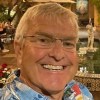

“A Minute Early or a Minute Late: Lessons from the Cold War” was the subject of an interesting conversation held by Santa Barbara’s Channel City Club.
Before a packed, pre-Election Day audience at the University Club of Santa Barbara, speaker Frank Lavin discussed America’s foreign policy during the Cold War and its lessons for today.
Geopolitical uncertainty is running high with conflicts in the Middle East, Russia’s war on Ukraine, China’s aspirations and global tariff battles, making the need for prudent foreign policy essential.
Lavin has served three U.S. presidents (Ronald Reagan, George Bush 41 and George W. Bush 43), working in the Commerce and State departments, National Security Council and the White House.
He served as U.S. ambassador to Singapore, where he helped negotiate the 2004 U.S.-Singapore Free Trade Agreement.
Lavin is currently a columnist for Forbes, The Wall Street Journal and The Washington Post, and author of several books on government affairs.
In his remarks, he said foreign policy involves making decisions “a minute early or a minute late.”
For much of our country’s history, Lavin noted, there was little need for a foreign policy as our nation was focused on internal growth — and a minute late was just fine.
He said America was “small, poor and isolated” with little need for a foreign policy other than asking France to help fund our revolution and later simply trying to keep Europe out of our Civil War.
The United States was essentially “agnostic” about international affairs through much of the 19th and 20th centuries, pursuing an isolationist foreign policy, particularly regarding European conflicts and alliances.
That all changed in 1941 when Japan attacked Pearl Harbor. Our country quickly went to making decisions a minute early, Lavin said.
He noted that our nation’s new foreign policy from World War II and continuing into the Cold War-era created a global coalition and global messaging designed to bring the world together against a German, Italian and Japanese enemy.
“The United States has no higher mission than to build a lasting peace that enshrines liberty, democracy and dignity for individuals everywhere.”
PRESIDENT RONALD REAGAN
The United States took the moral high ground, Lavin said, focusing on human rights, democracy and the rule of law.
Critically, the United States had no imperial designs. We were looking to free the world from tyranny toward self-rule, not colonization.
Lavin noted that this foreign policy stayed intact after WWII as we entered the Cold War era, adding an array of “carrots” that included decolonization, foreign aid, and institutions like the World Bank and the Peace Corps created by President John F. Kennedy.
According to Lavin, the strategy was that of “containment,” simply trying to stop the spread of communism.
Reagan, he said, changed foreign policy beyond containment to a “victory doctrine” — a “we win/they lose” strategy by “the good guys.”
Key to this policy was the Strategic Defense Initiative, popularly nicknamed “Star Wars,” a proposed U.S. missile defense system announced in 1983. The goal was to end mutually assured destruction of nuclear war by creating a defense shield for the United States.
Mikhail Gorbachev, president of the then-Soviet Union, tried to bargain with Reagan to cancel the plan. But Reagan refused to restrict SDI research and testing, effectively taking away the Soviet Union’s main bargaining chip: its nuclear weapons arsenal.
This one foreign policy decision dramatically changed the political landscape as the Soviet Union fell apart, Lavin said.
But Lavin observed a broad change in American attitudes toward global commitments over the past four administrations, as Presidents Barack Obama, Donald Trump, Joe Biden and Trump again viewed global strategy as too extended and too expensive, and sought to reduce our international commitments. Being a minute early was now too expensive.
Lavin described assisting allies like Ukraine, Israel and friendly nations in the Middle East with money and weapons but letting them fight their own battles.
Deterrence without entanglement would enable the United States to contain aggressive authoritarian expansion (whether in Ukraine, the Middle East or the Indo-Pacific) without direct U.S. military intervention or endless troop deployments.
Lavin answered questions from an informed audience about a variety of issues. He talked about the rise of populism being based on citizens who are unhappy about the system creating an emotional connection with candidates who focus on these grievances.
He also talked about exculpatory politics in which others are blamed for problems. As an example, he pointed to steel, a product that is expensive and heavy. The use of steel has declined over the last 70 years, reflecting changes in manufacturing, materials, technology and productivity, yet the Trump administration blames foreigners for declining domestic production.
The same goes for aluminum, which Canada can produce more cheaply, and which American manufacturers can use in products made by more workers than would be employed making aluminum ourselves. I thought Lavin made interesting points.
Personally, I miss the era of our nation living up to Reagan’s vision of being “the good guys” taking the moral high road as a beacon for liberty, democracy and dignity.
Modern foreign policy may say we can’t afford it, but I wonder if we can’t afford not to.
Click here for more information about the Channel City Club, and join us for important, thought-provoking conversations like this.
Upcoming Events
- Dec. 10 — Christmas brunch at the Hilton Santa Barbara Beachfront Resort with Westmont College President Gayle Beebe as the keynote speaker, along with emcee Bill Macfadyen, publisher of Noozhawk, and the Montecito Union School Chorus.


