


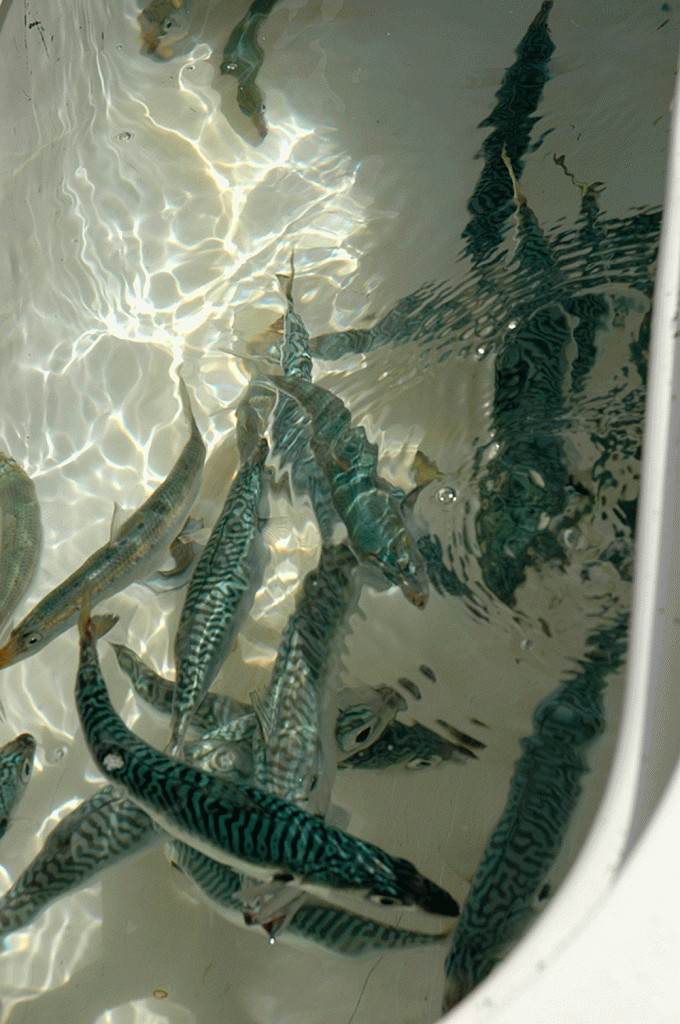
Our live bait operations at our local harbors sell anchovies and sardines, but few people understand how the live bait gets there and ultimately into bait tanks aboard our fishing boats.
Sportfishing is often referred to as live-bait fishing, illustrating how important live bait is to us.
The live bait story begins at sea in the dark of night where captain and crew (called bait haulers) work wet and cold, long and hard to find and catch live bait.
They search all along the coast, or many miles out at sea, looking for schools of anchovies and sardines on the surface, where the crew can net them.
The bait boat pulls up, puts out one end of a long purse seine net and runs net off a large drum as the boat circles around the bait.
Then the net is pulled tight at the bottom and up against the side of the boat. The baitfish are scooped with long-handled, no-knot scoop nets into the large holding tanks aboard the bait boat.
Great care is taken to exclude and protect non-targeted species, which happen to be among the bait. Then the nets are reeled back onto the drum, ready for the next set.
The ride to harbor is slow and gentle to avoid damage to the fragile cargo. Once at the receivers, the bait is slid through a large tube from the holding tanks aboard the boat and into the waiting net-lined receivers.
If some of the receivers have bait left from the prior load, it is commonly sold while the new load “cures,” or rests and feeds to gain strength.
When it is time to sell the bait, it is “crowded” within the receiver into netting stretched between poles or netting stretched within a rectangular frame, making it easier for the bait receiver attendant to scoop the bait into a long handled scoop net for passing to the bait tank aboard a fishing boat.
During the selling process is when customer protocol and courtesy come into play. The best way for multiple boats to stay organized and calm is to queue up near the receivers, roughly in a line, and wait for a turn.
It sure helps to maintain a somewhat orderly line, because if one boat drifts away, and then comes motoring back in demanding its place in line, it looks to new arrivals like someone is trying to cut in line. That can cause problems.
Commercial passenger-carrying fishing vessels (CPFV), such as party boats and 6-Pak boats, typically get served right away because they are commercial operations on a strict time schedule, plus our mortgages and repeat business depend upon it.
This sometimes bothers a few private boaters, but the reality is that without the commercial operations, there likely wouldn’t be any live bait available for private boaters.
