

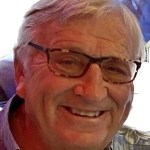


Valerie Yoshimura, left, with fellow organizers of the Nihonmachi Revisited exhibition, which celebrated the Japanese-American heritage of Santa Barbara’s presidio neighborhood. 
Original cast members of a 1986 performance of Una Pastorela, “demons versus San Miguel.” 
Shepherds gather in a scene from Una Pastorela, circa 1986. 
Mas Shimoda, longtime gardener of El Presidio de Santa Bárbara State Historic Park, taught Japanese and the martial art of Kendo in the presidio neighborhood’s Japan Town before and after World War II. 
Mas Shimoda leads a demonstration of the martial art of Kendo at the Nihonmachi Revisited celebration. 
A sign inside the Presidio Chapel describes the Nihonmachi Revisited celebration. 
Valerie Yoshimura assembles an exhibit for the Nihonmachi Revisited celebration. 
The Presidio Chapel was transformed into a museum for the Nihonmachi Revisited exhibition celebrating the presidio neighborhood’s Japanese-American heritage.
[Noozhawk’s note: Tenth in a series. Click here for previous columns.]

Just before the Santa Barbara Trust for Historic Preservation began planning for the dedication of El Presidio de Santa Bárbara’s rebuilt chapel on Dec. 12, 1985, a gentleman named Francisco González showed up at my office with a unique proposal.
He suggested we host a play in the chapel entitled Celebración de Los Cuarto Apariciones de la Virgen de Tepeyac (Celebration of the “Four Apparitions of the Virgin of Tepeyac”). The play portrays one of the most important Mexican cultural events celebrating the conversion of Juan Diego to Christianity, a symbolic representation of Mexico’s conversion to Catholicism.
I was game and said let’s go for it. Set to music by González, one of the founders of the Los Angeles rock band, Los Lobos, the play was presented in three evening performances that December, and was an incredibly moving experience.
It was only going to get better as González next proposed that we do an annual Christmas play with origins in Mexico, Spain and the Southwestern United States, Una Pastorela. This play was likely performed in the original Presidio Chapel as the script for it had been copied down by Pablo de la Guerra, son of presidio comandante José de la Guerra.
González used this script, added some lines in English, wrote the music and thus we were to have a version that would be performed at Christmas in the chapel into the 1990s. The story tells of the shepherds’ travel to Bethlehem, the devil’s intervention to prevent them from reaching the Christ child and their final rescue by the archangels San Miguel and San Gabriel.
The play was a wild success, drawing well over 1,000 people annually to the performances. We suddenly realized the chapel was to be more than a static museum; it was going to bring history to life.
One year, the cast of Una Pastorela was asked and accommodated a request to give performances at Mission San Fernando Rey de España in Los Angeles.
Although González no longer resides in Santa Barbara, local resident Elvira Tafoya has maintained the tradition of Una Pastorela during the Christmas season. She even did a performance of it before the chapel was finished in the early 1980s.

González also did other plays indoors and outdoors at the presidio, and helped keep alive early California music with singer and presidio descendant Elizabeth Hvolboll. For these contributions, he was honored with the Pearl Chase Historic Preservation and Conservation Award in 2011.
Another person who shared her creative genius with the SBTHP was Valerie Yoshimura. Noozhawk readers will remember from a previous column the criticism of the trust for ignoring the presidio neighborhood’s Asian history during the Presidio General Plan process.
We tried to address that issue with a cooperative research project with graduate students in UC Santa Barbara’s Public History program, which resulted in a 1993 SBTHP publication, The Santa Barbara Presidio Area: 1840 to the Present, that included chapters on the Chinese and Japanese who lived and worked in the presidio neighborhood.
I also had a living reminder of the site’s Japanese-American history in the person of Mas Shimoda, the gardener of the SBTHP and El Presidio de Santa Bárbara State Historic Park properties, who was a member of the original Japanese community and taught Japanese and the martial art of Kendo in the nearby Buddhist temple. In the back of my mind was some kind of event at the presidio honoring the Japanese heritage of the neighborhood.
The idea might have slipped away into my Don Quixote imagination, except a young woman, the aforementioned Yoshimura, came into my office in late 1990 looking for part-time work. Studying French at UCSB, she wanted to gain experience in the museum world. I shamelessly said to her that I did not have a paying position but if she cared to volunteer to help plan a Japanese-American event, I welcomed her assistance. What followed still amazes me to this day — 30 years later.
Yoshimura decided to commit to organizing an event she and others named “Nihonmachi Revisited: A Celebration of Santa Barbara’s Japanese-American Heritage.” It became an incredibly successful two-day event, and I will mention at least a few of the details.
With her partner, Bill Shay, and with the cooperation of many people from Santa Barbara’s surviving Japanese-American community, Yoshimura put together a team and a plan for an event in May 1991 that included entertainment, Japanese food and a museum exhibition in the Presidio Chapel.
Of all the great things Yoshimura did, turning the chapel into a museum space interpreting the history of Santa Barbara’s Japan Town was the most interesting. On her own she researched the history of the Japanese in Santa Barbara, and from this research created — with lots of help from other volunteers — eight outstanding panels of photos and text that were displayed in the chapel, along with other artifacts and objects interpreting the local Japanese-American history.

Yes, it was a truly memorable exhibition, and it was fitting since the Buddhist temple once stood on the chapel site. In her typical modesty, Yoshimura gave due credit to the many who volunteered their time to the exhibition, the music, dancing and other activities that took place at the state park. But this event could not have happened without her.
Yoshimura even spearheaded raising the $11,000 needed to cover expenses. The event ended up turning a profit, proceeds from which were used to bring civil rights leader Fred Korematsu to a special symposium later in the year in the chapel, where he discussed President Franklin D. Roosevelt’s Executive Order 9066 that had interned Japanese-Americans during World War II. Korematsu shared the story of his conviction for resisting the order and the efforts that eventually led to his conviction being overturned in 1983.
Nihonmachi Revisited brought more than 2,000 visitors to the park and established a tradition of celebrating the presidio’s Asian history. To this day, I feel the deepest gratitude to Yoshimura, who earned her Ph.D. in French at the University of Michigan, married Shay, is the mother of two grown children, and teaches French at Laguna Blanca School.
Yoshimura is a true star in the Santa Barbara Trust for Historic Preservation firmament. She and González had literally set the stage for a site that would have many more opportunities to bring history alive.
Next up: Back to the adobe world.
— Jarrell Jackman is the former executive director of the Santa Barbara Trust for Historic Preservation. After receiving his Ph.D. in history from UC Santa Barbara, he taught for six years in Europe and Washington, D.C. In 2015, he was honored as a knight of the Royal Order of Isabel la Católica by Spain’s King Felipe VI and was named an honorary state park ranger by the California State Park Rangers Association in 2016. Click here for previous columns. The opinions expressed are his own.