


A voluminous draft report on Rob Lewin’s bookshelf at the Santa Barbara County Emergency Operations Center outlines a litany of disasters — seemingly of biblical proportions — that could befall the county.
Earthquake, wildfire, flood, tsunami, disease epidemic, terrorist attack, nuclear accident, civil unrest and more. All are all risks that Lewin and other local emergency officials, and the community, must plan and be prepared for.
| Emergency Preparedness 2017 | Complete Series Index |
“We unfortunately have had a lot of experience here in California … and in this county, where we’ve had everything from riots to earthquakes to flooding and significant wildland fires,” said Lewin, who heads the county’s Office of Emergency Management.
Lewin took the organization’s helm last year, bringing a wealth of experience to the job, including decades spent in the firefighting ranks, mostly recently as fire chief in San Luis Obispo County.
He voices confidence that Santa Barbara County will be up to the challenge of responding to a large earthquake or similar major catastrophe.
“I sleep well at night because I believe in the people around us,” Lewin told Noozhawk. “And I believe the people I work with are going to come together. We’re going to do the right things.
“It’s not going to be perfect, and it’s going to be hard, but I’ve seen some major incidents in California, and I know what we’re capable of mobilizing for and doing.”
That confidence is tempered by the knowledge that beyond the planning, the staffing and the training, government will be limited in its ability to respond to a major disaster.

There can never be enough firefighters, police officers, paramedics, public works crews and other government workers to attend to every problem arising in a major disaster.
That means that, especially in the early going, a lot of people — maybe most — will be on their own when it comes to the basics of life: shelter, water, sanitation, power, medical care, transportation.
“The standard that we all use is three days, but I would say three to four days,” Lewin said of how long people should be prepared to take care of themselves.
A key challenge before calamity strikes lies in how to overcome inertia and human nature, and get people to take action to prepare themselves.
“How do we make sure in our own lives, either in your business or your home, that you’ve done what you can,” Lewin asked, noting that approaches such as the county’s Aware & Prepare initiative are a great resource.
“But I don’t know that we’re ever going to be really successful in getting people to prepare for disaster,” he said.
To prove his point, he cites the fact that roughly a third of all smoke detectors in homes and businesses don’t work at any given time.
“How do we break that?” he asked. “Unfortunately, it’s sort of the incident de jour.
“We’ve got to bombard them with messaging as best we can. I used to say, we’ve got to keep the smoke in their nose. We’ve got to keep reminding them.”
The ‘Big One’ is Coming
No one knows what disasters are in Santa Barbara County’s future, but there is general agreement that a large earthquake is a distinct possibility.
Generations of Californians have been schooled in the inevitability of the “Big One” — a major temblor that could lay waste to much of the state.
It’s not a matter of if one will occur, but when, according to the experts.

Scientists say it’s a virtual certainty that a major quake — of magnitude 6.7 or greater — will strike somewhere in the state within the next 30 years.
Even more sobering are the nearly 50-50 odds that a much larger quake — magnitude 7.5 or greater — will shatter California in the same time period.
The legendary San Andreas Fault — an 800-mile-long geologic scar that forms the tectonic boundary between the Pacific Plate and the North American Plate — is believed to hold the greatest potential for producing devastating shaking in the southern half of California.
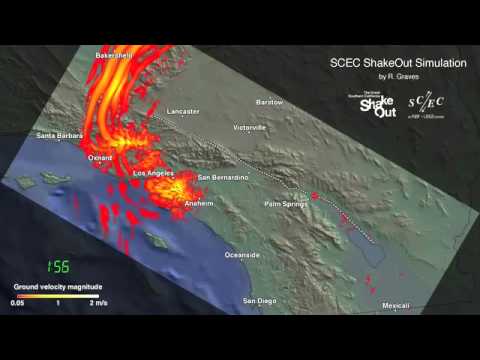
One scenario put forth by the Southern California Earthquake Center conjures a 7.8-magnitude quake caused by a 186-mile-long rupture along the San Andreas Fault — extending from the Salton Sea in the lower desert on the south to Lake Hughes northwest of Palmdale.
Computer simulations show that it would take a mere two minutes for the massive shock wave to hit Santa Barbara County.
Closer to home, emergency planners look to two faults as likely sources for a major local quake.
The Red Mountain Fault, which runs from the Ojai Valley along the west side of the Ventura River and out to the Rincon, could produce a magnitude-7.4 quake that would have its greatest impacts on the southern portion of the county.
The San Luis Range Fault in southern San Luis Obispo County could produce a magnitude-7.2 quake that would have its greatest effects in the North County.
Of course, there also are dozens of other local faults — known and unknown, both onshore and offshore — that could rupture and wreak devastation.
Regardless of the source, the damage and carnage from a major earthquake would be immense.

In the San Andreas scenario, nearly 400 people likely would be killed in the county, according to the county’s 2013 Emergency Management Plan, with another 1,400 suffering serious injuries.
Several thousand more would sustain minor injuries.
Some 43 percent of the region’s buildings would be at least moderately damaged, with more than 7,200 being beyond repair.
Building-related losses under this scenario are estimated at more than $8.4 billion.
Adding to the risks is soil “liquefaction” — the propensity for saturated soils to behave like a liquid during an earthquake, magnifying the potential for damage, especially given the number of older buildings in the area.
Water, sewers, roadways and utilities all would be disrupted, and Santa Barbara County likely would be on its own, at least in the first few days.
Depending on its epicenter, a major quake also could spawn a tsunami that could further devastate lives and property.
To repeat: It’s not if, but when.
After the Shaking Stops
In the immediate aftermath of a large earthquake — or any major catastrophe — the county’s emergency-operations apparatus would swing into action.
“The first thing is, we’ve got to do everything we can to get really good situational awareness,” Lewin said. “We need to understand what’s going on.”
The danger, he said, is “you can start chasing an incident. You might have the collapse of a building, and you think the worst scenario is the collapse of that movie theater, but you might have a school that has collapsed that’s much worse …
“So the whole ability to get good situational awareness is a concern during a major emergency that affects a large geographic area.”
The next step, he said, is to decide how to allocate emergency-response resources.
“We set priorities on these incidents — which is No. 1, No. 2, No. 3,” Lewin said. “And it doesn’t mean No. 3 doesn’t get anything; it just means the main focus is elsewhere.”
The first priorities typically would be attending to casualties — the dead and those who are injured — as well as problems such as fires, road and bridge failures, building collapses and similar problems.
The expectation is the medical system would be overloaded, necessitating a triage process.
Relatively quickly, officials would have to assess the condition of the community’s key infrastructure — water lines, the power grid, the sewer system — and develop plans for restoring service.
“We’ve got to immediately move into the mode of how do we adjust to things like no water, no electricity,” Lewin said.
They also would need to figure out how to provide shelter for potentially thousands of people.
Eventually, outside help would arrive through California’s well-tested “mutual aid” system, although in a massive quake even those resources likely would be strained.
As the hours after a quake or similar emergency stretch into days, and then into weeks, the focus inevitably would shift.
“We get into this recovery phase,” Lewin said. “How do we make our community a community again? How do we get people back? How do they rebuild?
“The real question is, how fast can we get back to what’s now the new normal? That’s our goal in emergency management. Can we get society back to some place?
“Now it may not look exactly the same. The downtown may not look the same again, which is the case for places that have had tornadoes or earthquakes. But can we make it into what we want it to be? Can we keep people here? Can we keep our community?”
One goal during a truly devastating incident is to have continuity of government, which Lewin said the county has plans for.
“But how do businesses maintain their continuity so they don’t flee and take jobs with them?” he asked. “How do we get back our industry, our tourist industry? How do we keep open for business, because so many people’s livelihoods in this area rely on that?”
Yolanda McGlinchey, emergency services coordinator for the City of Santa Barbara, echoes Lewin’s assessment.
“From the city’s perspective, what we try to do is make our plans so that we keep our infrastructure of the city going,” she said.
McGlinchey is active with the Aware & Prepare program, “helping the community to realize they basically need to take care of themselves for a while” after a major disaster.
Various programs are available to help members of the community prepare for a major disaster. They include the in-depth Community Emergency Response Team (CERT) training program run by the county Fire Department, as well as the shorter Community Disaster Education classes held by the City of Santa Barbara.
In each case, the idea is to provide a volunteer force that can supplement the professional emergency responders, and help the community get through a major emergency.
“We try to do a lot to promote people being ready,” McGlinchey said. “The city is going to do what it needs to do to help the residents in terms of infrastructure.
“But the city has only seven fire stations and 28 firefighters at a given time. If you are looking at 28 firefighters trying to go out and help 80,000 residents, plus tourists, etc, you really need to be prepared.”
» Click here to sign up for Aware & Prepare.
| Emergency Preparedness 2017 | Complete Series Index |
— Noozhawk executive editor Tom Bolton can be reached at tbolton@noozhawk.com. Follow Noozhawk on Twitter: @noozhawk, @NoozhawkNews and @NoozhawkBiz. Connect with Noozhawk on Facebook.
