


Santa Barbara County Air Pollution Control District (APCD) is offering tips for residents to plan for poor air quality caused by potential future wildfire smoke.
Smoke and ash contain very small particles known as particulate matter (PM), which can travel from wildfires even hundreds of miles away, APCD said. These particles harm the lungs and heart, and can cause coughing, wheezing, difficulty breathing, chest pain, and nausea.
Children, seniors, pregnant women, and people with heart or lung conditions are especially vulnerable to smoke.
The best protection against wildfire smoke is to stay indoors as much as possible. Here are three key ways to prepare:
1) Know how to check air quality conditions. Wildfire smoke conditions can change rapidly. APCD’s website provides the latest information in English and Spanish, using the color-coded Air Quality Index (AQI). The AQI colors help make health-protective decisions (“Green” means “Good” to go outside etc.) — see this AQI chart.
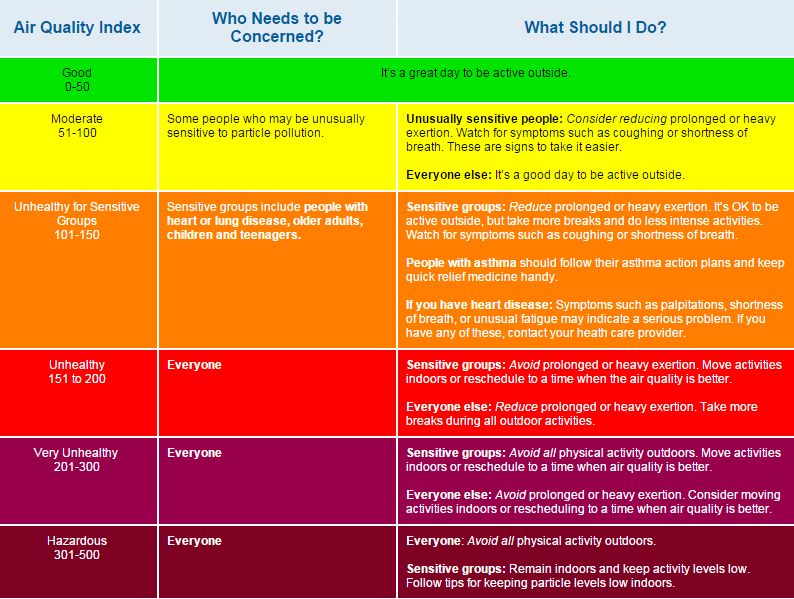
• 24/7 current conditions for each of APCD’s permanent monitoring stations, and three-day forecasts with newly improved geographic zones: www.OurAir.org/todays-air-quality/
• Map with APCD’s monitors and air quality sensors: https://fire.airnow.gov/.
2) Create a “clean air room” at home. A “clean air room” is where you set up an air filtration device, such as a HEPA (High-Efficiency Particulate Air) purifier or a DIY version of an air purifier. These devices remove indoor PM by more than 90 percent.
Below are some tips to make a “clean air room” most effective. Find videos and infographics on APCD’s website.
• Use the device in a room where you spend a lot of time, like a family room.
• Make sure windows and doors are tightly sealed.
• Avoid sources of indoor air pollution like candles, incense, and stovetop cooking.
Using a HEPA device:
• A HEPA purifier can be purchased at hardware and big-box stores or online retailers. They come in
various makes and models, suitable for different-sized rooms. Prices start at about $100.
• You can move the air purifier around depending on where you are spending your time, as long as the
square footage of the room is compatible with the recommended room size for the device.
• Replace the filter as directed in the owner’s manual, more frequently if used during a wildfire.
Using a DIY version of an air purifier:
- A DIY version can be more affordable (about $45 for materials). Here’s how to make your own:
o Use strong tape to attach a 20×20 MERV-rated air filter — like you would use for your HVAC system — to a 20×20 box fan. Attach it to the back of the fan for a better seal.
o Use a filter with a MERV rating of 13.
o Check the filter for the direction of the air flow, marked on the side of the filter.
• As needed, disassemble the box fan to wipe away any accumulated dirt.
• For safety, follow these precautions: Use a box fan that is from 2012 or newer, due to added safety features. Don’t leave the device unattended, and turn it off while sleeping. When the fan is modified like this, use the device as an air cleaner, not as fan to cool your home. - 3) Sign up for Air Quality Alerts. You can receive email and/or text notifications, in English and Spanish, when air quality is unhealthy at www.OurAir.org/subscribe.